
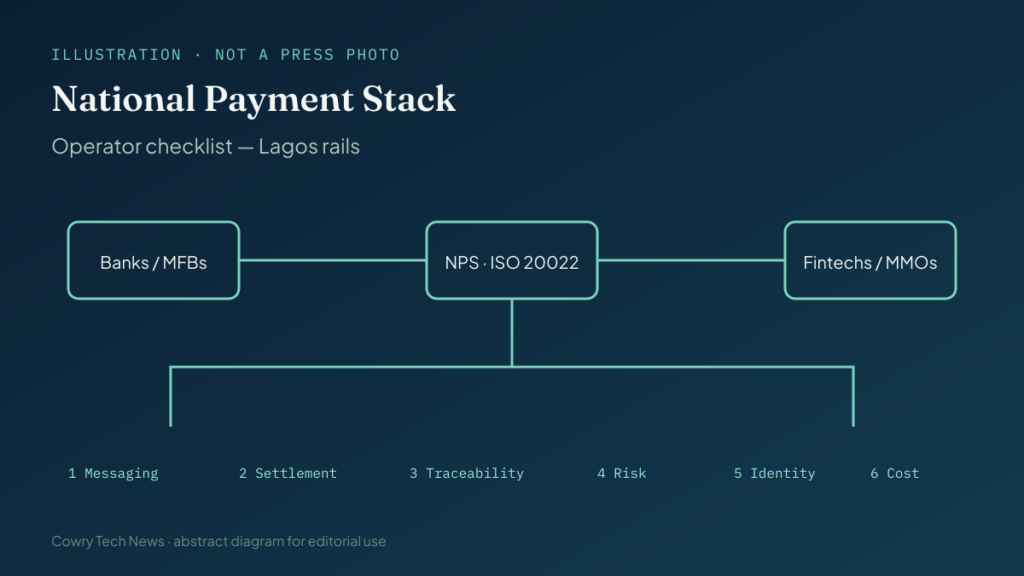
Nigeria Inter-Bank Settlement System (NIBSS) PLC says its National Payment Stack (NPS) surpassed 100 million successful transactions as of Friday, 25 September 2026. Nigerian business and tech coverage carried that figure at the end of September, with Managing Director and CEO Premier Oiwoh as the company voice. Cowry Tech News is treating the volume number and the Oiwoh quotes as announced through secondary press until NIBSS posts a hosted release on nibss-plc.com.ng. What NPS is built to do is documented on NIBSS’s own National Payment Stack page.
For operators between Yaba, Victoria Island, and the agent networks behind both, this is rail talk. Remita’s consumer app at Nigeria Fintech Week is a different beat. NPS is one standardised stack, ISO 20022 messaging, and a claim that commercial banks, microfinance banks, fintechs, mobile money operators, and payment service providers can share a foundation instead of stitching older rails for every new product.
What NIBSS says NPS is
On its product page, NIBSS describes NPS as a secure, unified digital platform meant to simplify and accelerate payments across Nigeria and beyond — from small transfers to multi-million-naira disbursements. ISO 20022 sits at the centre: structured, richer transaction data; better automation and accuracy; and a path to global interoperability. The page also lists operator-facing capabilities that matter if you run payments in production:
- Real-time visibility into settlement-limit net position, with immediate processing framed as a liquidity and confidence feature.
- Cross-border compatibility claims for local and international payments on a standards-aligned design.
- Smart risk scoring that flags high-risk transactions in flight, plus continuous monitoring language around fraud prevention.
- APIs and open-banking readiness for fintech integration.
- Integrated digital identity hooks for verified participation.
- End-to-end payment traceability — track a transaction from origin to destination.
- Insights and analytics dashboards aimed at decisions and compliance reporting.
NIBSS’s FAQ language on the same page positions NPS as payment infrastructure based on ISO 20022, with richer data and tighter integration. Compared with older rails, NIBSS says NPS allows rich data such as invoice numbers, customer references, and payment purpose; supports bulk and single payments; supports reversals and refunds; offers real-time insights into settlement positions; supports multi-currency transactions on a single rail; and supports cross-border payment interoperability. NPS is also described as supporting real-time payments in the spirit of the existing NIBSS Instant Payment (NIP) system, “but with more intelligence and tracking capabilities.” That comparison is NIBSS’s own framing. Useful for product managers. Not a third-party benchmark.
None of those capability bullets were independently audited for this piece. They are the vendor’s published product claims. The 100 million figure is a volume milestone. It does not prove every listed feature is live and uniform for every participant type.
Why the milestone matters on Lagos rails
Press coverage repeating the NIBSS announcement — including Independent Newspaper Nigeria on 30 September 2026 — stresses full ISO 20022 compliance and aims at interoperability, straight-through processing, transparency, fraud monitoring, and regulatory reporting. The same coverage argues that a single standardised rail cuts integration complexity and cost-to-serve across commercial banks, MFBs, fintechs, MMOs, and payment service providers.
If you have shipped against Nigerian payment rails before, you already know why that lands. Every extra adapter between a core banking system, a fintech ledger, and a switch shows up as engineering time, reconciliation breaks, and support tickets that ignore your roadmap. A volume milestone does not erase that history. It does change the default assumption: NPS is being presented as production infrastructure, not a pilot brochure.
Oiwoh’s quoted line in Independent coverage is clear about intent:
“Surpassing 100 million transactions on the National Payment Stack is a validation of our collective resolve to build a world-class payment system for Nigeria. With ISO 20022 compliance at its core, NPS is not just processing transactions; it is securing livelihoods, empowering the last mile, and strengthening the resilience of our entire financial ecosystem.”
Read that as an ecosystem claim. Validation language from the rail operator is expected. What Lagos teams still need — and what public coverage pulled for this story does not yet supply — is a breakdown of which transaction types and which participant tiers drove the 100 million, and under what service levels.
NIBSS, again via the same coverage, reiterates collaboration with the Central Bank of Nigeria (CBN), deposit money banks, microfinance banks, payment service banks, fintechs, and other stakeholders. That is the institutional map. It is not a published integration mandate with dates for every licence class.
Operator checklist: questions before you treat NPS as done
Use the milestone to interrogate your own stack. Do not paste the press release into a board deck and call the work finished.
1. Messaging and data model. ISO 20022 is not a sticker. If your internal payment objects still assume thin legacy fields, “rich data” (invoice references, purpose codes, customer identifiers) will stop at the edge. Ask your payments lead which NPS message types you emit and consume today, and which fields get dropped on the way into your ledger.
2. Settlement visibility. NIBSS advertises real-time access to settlement-limit net position. Confirm whether your treasury and liquidity desks see that signal in the tools they already trust, or only in a portal nobody opens during an incident.
3. Traceability versus support reality. End-to-end traceability is a product claim. In practice, can a Yaba fintech on-call engineer and a bank operations team pull the same transaction journey without a three-day email chain? Document who owns the ticket when NPS, NIP, and your own ledger disagree.
4. Fraud and risk scoring. In-flight colour-coded risk indicators and continuous monitoring appear on the NIBSS product page. That is not your AppSec and fraud programme. Ask what signals you receive, what you are expected to act on, and what remains your liability when a high-risk flag is wrong in either direction. (Trust-desk depth belongs with Arjun when product security claims need a buyer-literacy cut.)
5. Identity hooks. “Integrated digital identity” on a national stack sits next to Nigeria’s existing identity rails, including BVN-related services elsewhere in the NIBSS portfolio. Map which identity checks NPS assumes for your use case so you do not double-charge customers for friction you already impose upstream.
6. Coexistence with NIP and the rest of the NIBSS catalogue. NIBSS still publishes NIP, NQR, collections products, and other services alongside NPS. Your architecture diagram should say what moves to NPS, what stays on NIP, and what remains product-specific. “More intelligence than NIP” is a direction. It is not a migration runbook.
7. Cost-to-serve evidence. Coverage claims lower cost-to-serve and faster innovation from a single rail. Ask integrators for their own before/after: engineering hours, reconciliation breaks, and failed-payment rates. The national volume headline alone is not enough.
8. Cross-border. Multi-currency and cross-border interoperability appear in NIBSS product language. If your roadmap includes corridor payments, demand the specific schemes, currencies, and partner rails in scope for your licence. Keep PAPSS or other corridor stories in their own file.
Last mile: inclusion claims without soft-pedalling constraints
Announcement coverage extends the milestone to small businesses, merchants, agents, and unbanked citizens — faster, more reliable, more secure access to digital financial services. NIBSS’s product page makes a similar inclusion case: connect the unbanked and underbanked; improve social benefit disbursement, tax collection, and revenue tracking; enable secure real-time payments with built-in fraud detection; support domestic and cross-border flows; align with Nigeria’s digital economy goals.
Those aims are real policy and product targets. Lagos operators also know constraints that do not disappear when a national counter ticks past 100 million: agent liquidity on a bad cash day, power and connectivity on the edge, FX pressure on treasury desks, and customers who abandon a flow that asks for one verification too many. A sovereign, standards-aligned stack can still fail a merchant in Surulere if the last hop is down. It can also quietly succeed for MDA disbursements and bank-fintech corridors that never trend.
For a payments lead in Lagos, the practical test is mundane. Can your agent network settle when cash is tight on a Friday? Does a failed NPS-path payment surface the same reference your support team already uses for NIP disputes? If the answer is “we will find out after cutover,” the 100 million headline is marketing, not readiness. Agency-first coverage means naming those operational tests without turning them into a deficit story about Nigeria.
Do not flatten Nigeria into one payments personality. NPS is national infrastructure language. Adoption and pain remain local — licence type, city, corridor, and customer segment.
On the product page, NIBSS also frames NPS as “Built for Nigeria, Connected to the World” — sovereign and standards-aligned, with language about serving rural towns and urban tech hubs alike. That geography claim is useful branding. It is not a published coverage map of live NPS endpoints. Operators should still verify connectivity and certification status for their own channels rather than infer national uniformity from the volume headline alone.
What we still do not know
Public materials reviewed for this draft do not provide:
- A NIBSS-hosted press URL dedicated to the 100 million announcement (soft hold remains).
- A breakdown of the 100 million by payment type (P2P, merchant, bill pay, MDA, cross-border, and so on).
- Published latency, uptime, or incident SLAs tied specifically to the milestone window.
- Named participant counts (how many banks vs fintechs vs MMOs actively clearing on NPS for the counted volume).
- Independent third-party performance benchmarks comparing NPS to NIP under load.
Until those appear in primary documents, Cowry Tech News will not invent them. Volume is a signal. It is not a substitute for an SLA.
What to watch next
Watch for a NIBSS media release or circular-style note that pins the 100 million figure to methodology (what counts as “successful,” which services are in scope). Watch for integrator case notes — banks and fintechs describing ISO 20022 field usage, reconciliation changes, and support models in production language rather than launch language. Watch for policy and supervisory texture: CBN instruments or guidance that change who must be on which rail when. Process-heavy reading sits with the Abuja desk; product-trust reading sits with the security desk. This Lagos piece stays on operator reality.
Until methodology is public, treat secondary-press repetition of the same Oiwoh quotes as one announcement echoed, not as independent confirmation. Corroborating outlets in the same window (Guardian, The Sun) help show the story moved through the market. They do not replace a primary release URL or a participant breakdown.
NIBSS’s own commitment line in coverage — working with CBN and the licensed ecosystem toward a secure, inclusive, competitive payments system — is the institutional horizon. The near-term job for builders is narrower: decide what NPS changes in your message catalogue, your settlement view, and your incident path before the next volume headline.
Sources and method
- NIBSS National Payment Stack product page (capabilities and FAQ framing): https://nibss-plc.com.ng/national-payment-stack/
- Independent Newspaper Nigeria, 30 September 2026 (milestone as of 25 September 2026; Oiwoh quotes; ecosystem collaboration line): https://independent.ng/nps-hits-100m-transactions-deepens-financial-inclusion-security-nibss/
- Corroborating secondary coverage: Guardian, The Sun (same milestone window and Oiwoh framing).
- Brief desk context: Cowry Tech News approved Brief archive for 2026-10-01 (Desk-only; not a WP source).
Milestone attribution remains secondary press pending a NIBSS-hosted release. Product capability bullets are NIBSS-published claims, labelled as such. No partner lists, pricing, or performance metrics were invented for this draft.