
A case study of what Fixoral does for homeowners and local service providers, how it describes its value, and where its limits sit.
Most homes run on memory. Someone remembers roughly when the furnace was last serviced. A receipt for the water heater sits in a drawer, or in an email thread nobody can find. The plumber who did good work two winters ago is a name in somebody’s phone, if anyone saved it. When the house is sold, most of that history leaves with the old owners.
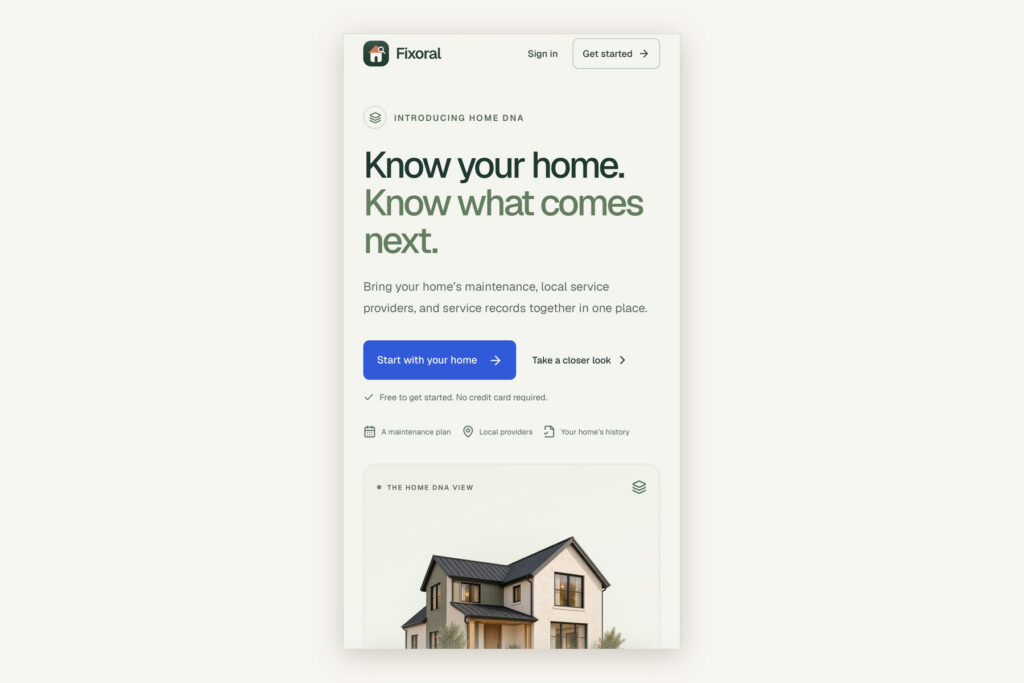
Fixoral is a web app built to put that history in one place and to tell the owner what is due next. Its tagline is “Know your home. Know what comes next.” Fixoral says it passed 1,000 monthly active users; CTN has not independently verified this figure. It has not published how it counts an active user.
This piece describes how the product works, based on Fixoral’s public product pages, terms of service and privacy policy, and on what the company told CTN. We could not include screenshots, and we did not run a home through the app ourselves.
What Fixoral is
Fixoral calls its homeowner product Home DNA. The homepage describes it as a way to “bring your home’s maintenance, local service providers, and service records together in one place.” Signing up is free, and the site says no credit card is required. Fixoral told CTN that homeowners get the first three months free, then pay $9 a month for the Basic homeowner plan, $19 for Plus or $29 for Pro. That homeowner Pro plan is separate from Fixoral Pro, the provider product. Those prices are not yet shown on fixoral.com. Fixoral told CTN the free trial turns into a paid plan automatically when the three months end, so homeowners who don’t want to pay should note the date.
The product is organised around three steps, which the homepage labels Plan, Connect and Remember.
Plan. A new user enters a property, and Fixoral builds a starter maintenance schedule based on the property type and its equipment. The privacy policy says the app can pull property details from RentCast, a US property-data service, to fill in the profile automatically. Tasks such as “Replace air filter” arrive with suggested dates, and the owner can change the tasks, the dates and how often they repeat. The schedule can be filtered by home and by category, and overdue items are flagged.
Connect. When a task needs a professional, the homeowner can look for providers whose ZIP code and service radius cover the property, send a request with the task attached, review a quote and coordinate the work. Fixoral describes this as “local matching.” Its own pages add that results “depend on participating providers” and tell users to “confirm availability and suitability directly before booking work.”
Remember. Service reports, receipts and documents are stored against the home. When a provider finishes a job through the platform, the homeowner can confirm it, and Fixoral marks the entry as homeowner-confirmed work. The idea is that the record stays with the property, so a future buyer, insurer or contractor can see what was done and when.
The work is grouped into ten categories: HVAC, plumbing, electrical, exterior, interior, appliances, home safety, seasonal maintenance, landscaping and pest control.
Reminders can come by email or by text message. The privacy policy says users who opt in get monthly digests and weather alerts, with weather data drawn from the US National Weather Service.
Fixoral is a US product. Matching runs on US ZIP codes, and its property and weather sources are American. CTN covers it as a builder case study from inside the Lone Cowry group.
How it is meant to help homeowners
Fixoral’s pitch to homeowners comes down to three practical things.
The first is a schedule. Many owners know they should change filters, flush water heaters, check smoke alarms and clean gutters, but few know when they last did any of it. A dated list tied to the house turns general advice into tasks with due dates. Fixoral’s HVAC page is careful about this. It says filter timing “depends on the filter, equipment instructions, pets and household conditions,” and that “a general checklist does not replace a professional assessment.”
The second is a shorter path to help. Rather than starting a search from nothing, the owner sends a request that already says what the task is and which home it concerns. In principle that means fewer back-and-forth calls before a quote.
The third is the record. Fixoral suggests keeping the service date, provider, work performed, equipment details and receipts for each job. Its guide on service records says this history “can support conversations with a service provider, buyer or insurer.”
Fixoral’s team told CTN that the larger goal is peace of mind and a clearer picture of the home’s health: knowing what has been done, what is due and who can do it. Those are the company’s words for what it hopes users feel. CTN has no independent measure of whether users feel more at ease, and we are not vouching for the outcome.
“Home health” is the company’s description. On the public pages we reviewed, Fixoral does not publish a numeric home-health rating, and it does not say the Home DNA view assesses the physical condition of a house. What the view shows is the owner’s schedule, the tasks done and outstanding, and the records attached. A house can look tidy in the app and still have problems nobody has found.
How it is meant to help service providers
The provider side is called Fixoral Pro. Plumbers, electricians, HVAC technicians, landscapers and other trades create a listing, choose the categories they work in and set the ZIP code and radius they serve. Requests from homeowners in that area arrive in a dashboard, where the provider can respond with a quote. Fixoral Pro also includes templates for service reports and a system of what it calls verified reviews.
For a small trade business, the appeal is that a request arrives with context. The provider can see what the homeowner wants done and where. When the job is finished, the provider’s report goes into the homeowner’s record, which may matter when that customer needs the same service again.
Fixoral is direct about what it does not promise. The providers page says “lead availability depends on local participation; requests are not guaranteed.” The terms of service repeat this: “Fixoral does not guarantee any volume of leads, requests, or revenue.”
Fixoral told CTN that the first 100 providers get the service free, and the next 1,000 pay $199 a year. The company said billing was left out of its most recent site deployment, so the providers page still describes a free early-access listing. Its FAQ says Fixoral “never takes a percentage of your jobs,” which fits a flat annual fee rather than a commission.
The providers page also says “hundreds of local pros” already use Fixoral. That is the company’s claim, and CTN has not verified it.
What Fixoral does not do
The company’s own pages list several limits, and they are worth putting together in one place.
- It does not vet or employ providers. Its terms say Fixoral “does not employ, endorse, or guarantee any provider.” Providers enter their own licence and insurance information. Homeowners should check licences and insurance themselves.
- It is not a party to the job. Fixoral says it is “not a party to any agreement for services performed between a homeowner and a provider.” Disputes over price, quality or damage sit between the homeowner and the provider.
- It does not handle payment for work, at least during the beta. Money moves directly between the homeowner and the provider.
- It does not inspect your home. Schedules, suggestions and property data are provided “for informational purposes only” and “are not guaranteed to be accurate, complete, or suitable for your specific property,” according to the terms.
- It does not establish tax or insurance outcomes. Fixoral’s records guide says “a saved record does not establish that an expense is tax deductible” and that records do not “guarantee an insurance discount, a valuation increase or a professional certification of the home’s condition.”
- It does not guarantee local coverage. Whether there are providers near a given ZIP code depends on who has signed up there.
Limits like these are common for an early home-services marketplace. They also mean the value a user gets depends heavily on where they live and how much they put into the app.
How it handles data
A maintenance app collects more than it first appears to. Fixoral’s privacy policy, also dated August 6, 2026, lists account details, property addresses and details, phone numbers for people who choose text alerts, provider business and licence information, and basic usage and error data.
The policy says Fixoral does not sell personal information. It names the outside services it relies on: Supabase for the database, sign-in and file storage; Vercel for hosting; Stripe for provider subscription payments; Resend for email; Twilio for text messages; RentCast for property data; Google Places for address lookup; the National Weather Service for alerts; and error and analytics tools such as Sentry and PostHog.
Users can delete their account from settings, and the policy says this “permanently removes your personal data and associated records,” with limited exceptions such as payment records. It describes encryption in transit, access controls and row-level security in the database, and it says, as most policies do, that no system is completely secure. CTN did not test these controls. At the time of writing, the published terms did not yet name the company responsible for user data; Fixoral says content from its latest site deployment is still being consolidated.
One point for homeowners to weigh: a home record is useful because it holds a lot of detail, including the address, the equipment, the providers who have been inside and the receipts. That is also why it should be protected like any other personal file. Text alerts, for example, require handing over a mobile number.
The 1,000-user claim
The milestone behind this piece is Fixoral’s own figure. Fixoral says it passed 1,000 monthly active users; CTN has not independently verified this figure.
For context, 1,000 monthly users is an early number for a consumer app, and the more useful questions sit behind it. We don’t know how the users split between homeowners and providers, which ZIP codes they cluster in, or how many requests turn into finished jobs. For a two-sided marketplace, the density of providers in a given area matters more than the national total. A thousand users spread thinly across the country would give a very different experience from a thousand concentrated in a few metro areas.
Fixoral has not published its definition of an active user or the split between homeowners and providers. CTN will update this piece if those figures are shared and can be checked.
What a homeowner should check before relying on it
- Look for providers in your own ZIP code before you count on the Connect step. Coverage is uneven in any new marketplace.
- Treat the schedule as a starting point. Compare suggested intervals with your equipment manuals, and get a professional assessment where it matters.
- Verify every provider independently, including licence, insurance and references, since Fixoral does not.
- Agree scope and price directly and in writing. Fixoral is not a party to the job.
- Keep your own copies of important documents. A record in an app is only useful while you can get it out.
- Read the current terms if you are a provider, and confirm which pricing tier applies to you before you list.
Why CTN is covering it
Cowry Tech News covers small business software, payments and builders whose work gets little coverage. Fixoral fits the builder part of that brief. Software for home services is often built for large contractors or for lead resale. Fixoral’s design, at least on paper, puts the homeowner’s record at the centre and tells the provider plainly that leads are not guaranteed.
We are also aware of the conflict. Fixoral comes from the same parent company as this publication. That is why this piece carries a disclosure, why every benefit is attributed to the company, and why the limits get as much space as the features.
What this piece is not
This is not a product review, and it is not a recommendation to sign up. CTN did not test the app’s matching, reminders or records in a real home. We have not verified Fixoral’s user figure, its provider count or any outcome for homeowners. Nothing here is tax, insurance or legal advice.
Fixoral’s site is at fixoral.com.
Sources
- Fixoral homepage and Home DNA page, fixoral.com, accessed October 8, 2026
- Fixoral Pro providers page and FAQ, fixoral.com/providers, accessed October 8, 2026
- Fixoral guide on home service records and the HVAC service page, fixoral.com, accessed October 8, 2026
- Fixoral, statement to CTN on homeowner and provider pricing, October 8, 2026 (via Lone Cowry Ventures)
- Fixoral Terms of Service, last updated August 6, 2026
- Fixoral Privacy Policy, last updated August 6, 2026
- Fixoral, statement to CTN on its monthly active users and product goals (self-reported, not independently verified)
Disclosure: Fixoral is built by Lone Cowry Ventures, the parent company of Cowry Tech News. This is a case study of an affiliated product. It is not an advertisement. Figures and benefits below are Fixoral’s own claims unless we say otherwise. CTN has not independently tested the product’s outcomes. Fixoral’s statements in this piece reached CTN through Lone Cowry Ventures.