
The organiser of SATShow Week 2027 has posted the first sessions for GovMilSpace, the government and military program that runs inside the show. There are eight so far, and the organiser says more will be announced in the coming months. Still, an early agenda is a choice about what to put in the window, and this one is worth reading for what it suggests about US defense and civil space priorities going into March.
This is the second piece in our SATShow Week 2027 series. The first, our explainer on the week itself, covers what the show is, pass prices and the organiser’s attendance figures, so we won’t repeat them here. Briefly: SATShow Week runs March 8 to 11, 2027, at the Walter E. Washington Convention Center in Washington, DC, with the exhibition open March 9 to 11, according to satshow.com.
What GovMilSpace is
GovMilSpace is a track held alongside the SATELLITE conference, produced in partnership with the trade publication Defense Daily. The organiser describes it as “the only satellite conference built specifically for defense and intelligence.” That is its own description. The program is unclassified, and the organiser says sessions are not open submission: program chairs pick proposals for “mission alignment, operational grounding, and genuine value to the government and military audience.”
The GovMilSpace page also carries organiser figures for 2026, including that 34% of attendees were “gov, military, and civil space professionals” and that “900+” one-on-one meetings were arranged. These are the organiser’s claims and CTN has not audited them.
The page groups the 2027 program into six themes: Government-Commercial Partnership, Resilient PNT, Defense Innovation and Startups, Industrial Base and Supply Chain, Space Communications, and Reverse Industry Day Sessions. The last is described as “structured dialogue between government program offices and commercial providers on capability gaps and acquisition priorities.” No session under that theme has been posted yet.
The first sessions, as posted
All titles, names, job titles and times below are as they appear on the GovMilSpace page, read on October 13, 2026.
- Mon, Mar 8, 9:00 am. “Mission Partner or Investor? How the Government-Commercial Space Relationship Is Evolving.” Sherin Kamal, Sr. Advisor to JTNC Director, Joint Tactical Networking Center, U.S. Department of War.
- Mon, Mar 8, 10:00 am. “Proliferated Warfighter Architectures: Designing Defense Constellation Services for the Threat Environment.” Sho Nakanose, Founder/CEO, GITAI.
- Mon, Mar 8, 11:00 am. “Geospatial Intelligence at Machine Speed: How AI Is Changing What Analysts See.” Steven Kosvick, Constellation Architect, ICEYE US.
- Mon, Mar 8, 1:30 pm. “Space Domain Awareness: Who Owns the Picture and Can We Trust It?” Dhruv Jain (Moderator), Astrodynamics Engineer, Kayhan Space; Andrew D’Uva, Strategy and Policy Advisor, Space Development Agency.
- Mon, Mar 8, 2:45 pm. “Military Space Tech Opportunities for Non-Traditional or Startup Companies.” Janelle Teng Wade (Moderator), Partner, Bessemer Venture Partners; Lt. Col. (S) Robert Perez-Alemany, Program Manager, Space Portfolio, U.S. Defense Innovation Unit (DIU).
- Wed, Mar 10, 10:15 am. “GPS Is Not Enough: Resilient PNT for the Military Forces and Infrastructure That Depend on It.” Brian Manning, CEO & Co-Founder, Xona Space Systems.
- Thu, Mar 11, 9:30 am. “Connecting Humanity to the Stars: NASA’s Vision for the Future of Space Communications.” Greg Heckler, Deputy Program Manager, Capability Development, NASA SCaN; Marie Piasecki, Technology Portfolio Manager, NASA SCaN; Luke Staab, Communications Services Project Manager, NASA.
- Thu, Mar 11, 10:30 am. “Building the Industrial Base Before the Next Crisis: Manufacturing, Workforce, and the Domestic Space Supply Chain.” Nihar Shah, Chief Strategy Officer, SES.
Monday is the heaviest day, with five of the eight. Tuesday has none yet. Four sessions are worth a closer look because each ties to a public government program.
Space domain awareness and the Space Development Agency
Two different things share the initials SDA here. Space domain awareness is the general term for knowing what is in orbit, where it is going and what it might do. The Space Development Agency is a Defense Department organisation, and its strategy and policy advisor, Andrew D’Uva, is on the Monday afternoon panel.
The Space Development Agency says it was established on March 12, 2019. Its charge, in its own words, is to “create and sustain lethal, resilient, threat-driven, and affordable military space capabilities.” It does this through what it calls the Proliferated Warfighter Space Architecture, a large constellation built in layers that the agency lists as Transport, Battle Management, Tracking, Custody, Navigation, and Ground and Launch. The agency says it aims to field a new generation “every two years” and leans on commercial development to do so.
The session’s subtitle, “Who Owns the Picture and Can We Trust It?”, matches the organiser’s description of its Government-Commercial Partnership theme. The question is a fair one. A growing share of the tracking data on objects in orbit comes from commercial firms, and the moderator here is from one of them. Whether government users treat that data as a supplement or a dependency is the policy matter underneath.
DIU and the startup pathway
The Defense Innovation Unit is a Defense Department organisation that buys commercial technology for the military. DIU says it was launched in August 2015 as DIUx by then Defense Secretary Ash Carter. It describes itself as a “Field Activity” that uses open solicitations and Other Transaction Authority (OTA) contracting to award “prototype contracts in months, not years.” OTA is a contracting route that sits outside the standard federal acquisition rules and is meant for prototypes.
DIU’s own about page names the problem it was set up to address: barriers to entry “for first-time, nontraditional and small businesses are too high.” The Monday session borrows that word directly in its title. DIU’s current portfolio list includes one called Kill Web, which it describes as “rapidly scaling the sensors, networks, and decision systems enabled by commercial space advances.” A program manager for DIU’s space portfolio, sitting next to a venture investor, is a reasonable signal that the department wants startups to keep coming, and that investors want to know what the exit looks like.
Resilient PNT
PNT stands for positioning, navigation and timing. Gps.gov describes GPS as “a U.S.-owned utility that provides users with positioning, navigation, and timing (PNT) services,” and notes that it is operated and maintained by the U.S. Space Force. Timing is the part people forget.
“Resilient PNT” is the term used for ways to keep those services working if GPS signals are jammed, spoofed or lost. The organiser frames the theme as “moving beyond GPS dependence for the military forces and critical infrastructure that rely on it.” The Space Development Agency’s own architecture list now includes a Navigation Layer, so the idea has a place in at least one government program. The sole named speaker is the chief executive of Xona Space Systems, a commercial company. CTN has not checked Xona’s own claims about its system and makes none here. A session titled “GPS Is Not Enough” is unlikely to conclude that GPS is enough.
NASA SCaN
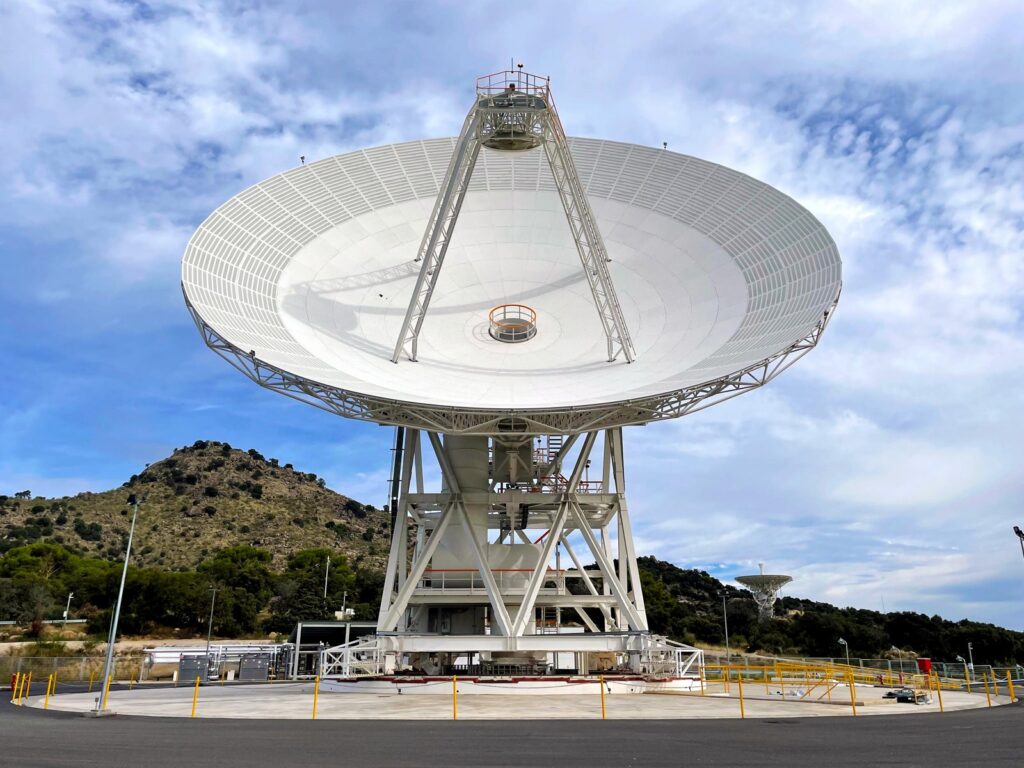
SCaN is NASA’s Space Communications and Navigation program. NASA says it “operates and manages the communications and navigation systems that are critical to every NASA mission.” It runs two networks: the Near Space Network, for missions within one million miles of Earth, and the Deep Space Network, an array of large antennas at Goldstone in California, Madrid and Canberra. NASA also says SCaN is “engaging the commercial industry for both direct-to-Earth and space relay communications services,” and that it supports communications for the Artemis lunar missions.
That commercial shift is the most likely reason a NASA panel turns up in a defense-flavoured track. The organiser’s theme line says the session covers NASA’s vision “and what it means for commercial partners.” It is also the only civil space session posted so far. Greg Heckler appears on the SATShow Week homepage as a featured speaker, where his title is written slightly differently, as “Deputy Program Manager for Capability Development.” The meaning is the same.
What the early agenda signals
Taken together, the eight sessions lean on one idea: the government as a customer of commercial space. Seven of the eight have a company or investor on stage. The industrial base session asks about manufacturing and the domestic supply chain “before the next crisis.” The geospatial session is about AI in intelligence analysis.
Some caution is due. This is an early preview chosen by a commercial organiser. It is partial and will change, and it reflects what the program chairs think the audience wants, not government policy. The six themes are a better guide to the final shape than the eight sessions are.
What to watch before March
- Whether the Reverse Industry Day sessions get named program offices.
- Whether any Space Force or Space Systems Command speakers are added. None are posted yet.
- Whether Tuesday, March 9, gets GovMilSpace sessions.
- Whether the resilient PNT session adds a government speaker alongside Xona.
Method note
CTN read the GovMilSpace page and the satshow.com homepage on October 13, 2026. Both loaded in full. Session details are copied from the GovMilSpace page. Agency descriptions come from the Space Development Agency, DIU, NASA and gps.gov websites. CTN did not request comment from the organiser or any of the speakers.
Disclosure: Lone Cowry, the publisher of Cowry Tech News, plans to attend SATShow Week 2027. It has no sponsorship or partnership with the event.
Sources
- SATShow Week, GovMilSpace 2027 page (read Oct 13, 2026)
- SATShow Week 2027 homepage (read Oct 13, 2026)
- Space Development Agency, About Us
- Defense Innovation Unit, About DIU
- NASA, SCaN: Communicating with Missions
- GPS.gov, National Coordination Office for Space-Based PNT, homepage (“What is GPS?”)
- Cowry Tech News, SATShow Week 2027 explainer (series piece 1)